Weather or Not: How St Albans Morris Men Decide Whether to Dance

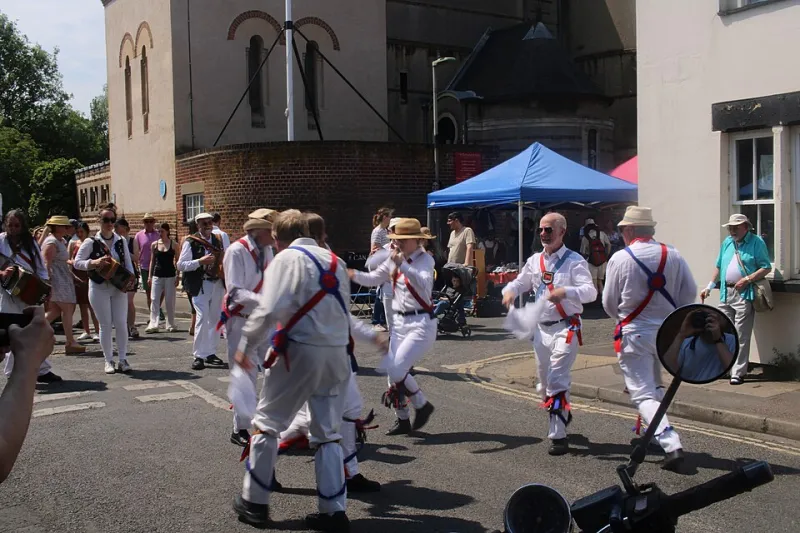
Photo: Morris dancers outdoors in rain with spectators under umbrellas in English town, via inventory.dealersocket.com
Anyone who has organised an outdoor event in Hertfordshire knows the feeling. You check the forecast on Monday, again on Wednesday, and by Friday night the app is showing a yellow warning for rain and a wind that could take a hat off. Morris dancing is an outdoor tradition, but it is not a careless one. Behind every stand there is a quiet conversation about whether the ground is safe, whether the hankies will turn into wet rags, and whether the pub has room if the sky decides to make other plans.
The decision starts before the day
St Albans Morris Men do not dance in all weathers, and they do not make the call on a whim. The side watches the forecast in the days before a dance-out, but it also looks at the ground. A light drizzle is usually fine. Standing water, ice, wet leaves on stone steps and gusty wind are a different matter. So is the temperature: bells and sticks are one thing, but numb fingers and slippery footwear are another.
The site matters as much as the sky. Cathedral steps, market-place cobbles, grass verges and pub yards all behave differently when wet. A stand that works beautifully on a dry June morning can become a serious slipping hazard in November. The side also thinks about the journey. If dancers are travelling from across St Albans, Harpenden and the villages, a forecast that looks marginal in one place may look worse on the road.
Surfaces, steps and soggy hankies
Morris kit is not designed for a downpour. Hankies get heavy, sticks lose their grip, and leather soles on wet stone can turn a neat side-step into a wobble. Bells are fairly hardy, but nobody wants to spend the following week drying out waistcoats and baldrics. More importantly, audiences and dancers share the same space. If the ground is treacherous for a fit dancer, it is worse for a child running about or an older spectator trying to get a better view.
That does not mean the side melts at the first spot of rain. A short stand in a sheltered market place, a flatter piece of grass, or a programme trimmed to the safer dances can all work. Sometimes the call is not dance or cancel, but dance differently: fewer sticks, more hankies, a static set instead of a procession, and a careful eye on the edge of the performance area.
Plan B is often a pub
The British weather has probably done more for pub landlords than any marketing campaign. If a dance-out is rained off, the side does not always go home. Often the plan shifts to the pub that was always going to be part of the day: a tune session, a chat, a dry corner and a chance to thank the people who came out to watch. It is not the same as dancing, but it keeps the social side of the tradition going.
A pub is not a failure of a dance-out. It is a sensible adaptation. Morris has always been a tradition that fits around real life, and real life in Hertfordshire includes wet Saturdays. If the landlord has space and the musicians are willing, a few tunes indoors can salvage the afternoon. Audiences should not expect a full stand in a downpour, but they can usually expect good humour.
How to check before you travel
If you are planning to watch St Albans Morris Men at a particular spot, check before you set out. The side uses its website and social media to share changes, and local event organisers often post updates too. If the weather is borderline, arrive early rather than late, and ask someone from the side if the stand is going ahead. Do not rely on last year's timetable or a vague memory of where the side usually dances.
It also helps to be flexible. A dance-out may start later, finish earlier, move to a different corner of the site, or shift indoors. None of that is chaos. It is the normal practical work of putting on live performance outdoors in a country that has four seasons in one afternoon.
Why a cancelled stand is not a failed tradition
It can feel disappointing when a dance-out is called off. The crowd has gathered, the pub has opened, the children have brought their grandparents. But a cancelled stand is not a failed tradition. It is a sign that the side takes safety and good sense seriously. Morris dancing has survived in St Albans since 1972 because it has been adaptable, not because it has been stubborn about every single booking.
There will be other Saturdays. There will be Boxing Day, the summer fetes, the village greens and the cathedral green. The bells do not stop ringing permanently because one forecast turned nasty. They wait for a drier day, a safer surface and a crowd that has not been blown halfway down the high street.
So if you turn up and find the side has moved to the pub, or shortened the programme, or called it off altogether, don't count it as a loss. Count it as part of the same old bargain: the dance belongs to the community, and the community includes the weather.