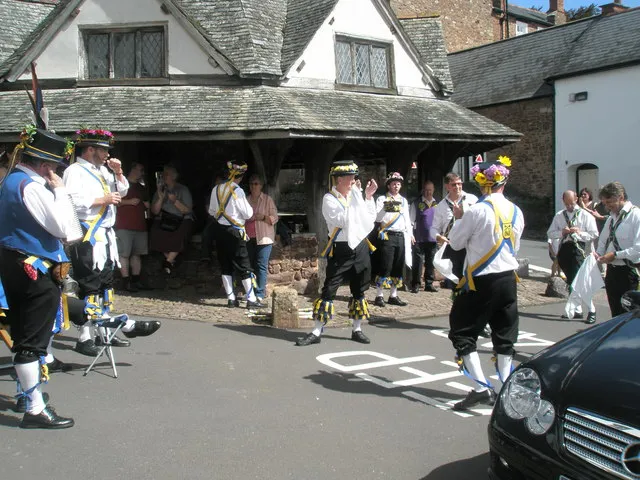
Framing the Clash: A Photographer's Field Notes on Shooting Morris Dancing
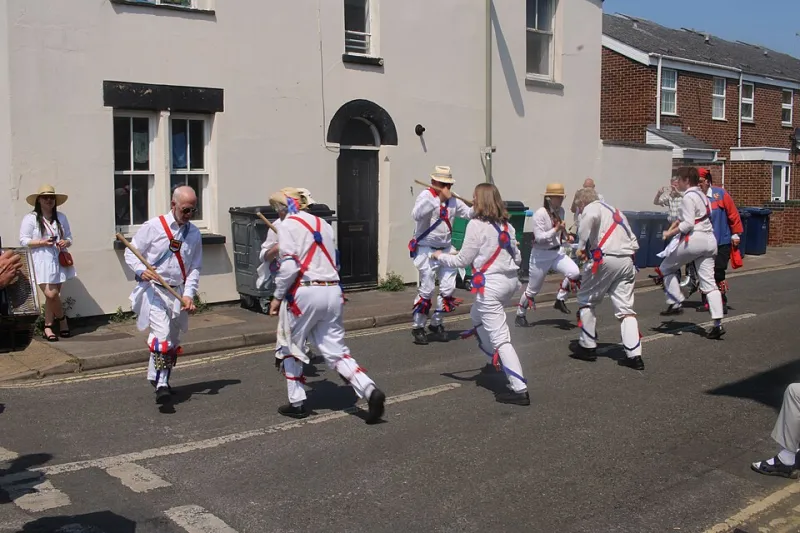
Photo: Pierre Marshall, CC BY 4.0, via Wikimedia Commons
Every summer, someone turns up at a St Albans fete with a very good camera, a very long lens, and absolutely no idea what is about to happen. They fire off nine hundred frames during a six-minute dance, go home with a card full of blurred sticks and the backs of people's heads, and quietly conclude that Morris is impossible to photograph.
It isn't. It's just rhythmic. And rhythm, unlike a toddler or a swan, can be learned in advance.
The Dance Tells You When to Press the Shutter
Morris looks chaotic from the outside and is, in fact, fiercely structured. A typical stick dance runs as a sequence of figures — the chorus, the half-hey, the corner crossings, the caper — repeated with slight variations, and every figure ends in a moment of punctuation. Sticks meet. Feet land. Hankies fly up and stop dead. Bells settle.
Learn four or five of those signposts and you stop guessing. The clash of sticks, for instance, is almost never a surprise once you've watched one full dance: the side sets up, the musician lifts the tune, and there's a half-beat of stillness before the strike. That stillness is your shot. A dancer balanced on one leg with a stick raised is a better photograph than the impact itself, because it holds the tension instead of resolving it.
The other reliable moment is the pause between figures, when the set reforms. Dancers glance at each other, breathe, adjust a hat. Those are the frames that show the people rather than the pattern, and they're the ones sides actually want for their own archives.
Why Burst Mode Is a Red Herring
A 20-frame-per-second burst sounds like a solution. In practice, you end up with twenty near-identical pictures and a card full of homework to sift through. Worse, you spend the dance looking at a screen instead of at the dancers.
A better approach is to shoot in short, deliberate bursts of two or three, and to keep one eye on the set rather than both eyes in the viewfinder. Anticipating a moment gets you a sharper, better-timed frame than hoping a machine finds it for you.
On settings, there's no single answer, but there are sensible starting points. If you want sticks and feet frozen, aim for around 1/500th or faster and let the ISO drift up — modern sensors cope far better with noise than with motion smear. If you want the bells and hankies to streak, drop to somewhere near 1/60th or 1/80th and pan with the dancer; you'll lose most frames, but the ones that work look like movement rather than a still life.
Single-point autofocus on the nearest dancer's chest beats wide-area subject tracking almost every time. Morris sets are busy, overlapping and full of sticks that will happily grab a focus point if you let them.
Kit That Earns Its Place in the Bag
You do not need a 600mm lens. You need to be close enough to see faces and far enough back not to be a hazard. A standard zoom covering roughly 24–70mm will handle most of a pub forecourt, and something in the 85–135mm range is lovely for tight portraits of the musicians. A fast prime is a gift at a winter stand, where the light on Cathedral Green in late December is roughly the colour of weak tea.
Bring a cloth. Morris happens outdoors in all weathers, and drizzle on a front element ruins more frames than poor technique ever will.
Manners Before Megapixels
Here's the part that matters more than any of the above. You are a guest at a dance, not the reason for it.
- Never step inside the set. The dancers are moving backwards, sideways and occasionally towards each other at speed, and a photographer crouched in the middle of the figure is a twisted ankle waiting to happen.
- Don't cross in front of the musician. The melodeon or fiddle is the side's clock, and breaking that eyeline breaks the dance.
- Skip the flash. It's startling, it's unflattering, and at an evening stand it will make you unpopular fast.
- Mind the collection. If a bucket is doing the rounds, stand back and let it pass; nobody wants to negotiate a lens hood mid-donation.
- Ask before publishing close-ups, especially of children. A cheerful 'mind if I use these on my blog?' takes four seconds and saves a great deal of awkwardness later.
- Tell the squire you're there. St Albans Morris Men are, on the whole, delighted to be photographed — but a quick word beforehand means someone will actively angle the set towards you.
And when you do share the pictures, credit the side and say where it was taken. That small kindness is how a hobby archive becomes a genuine record of a town's dancing.
Five St Albans Spots That Flatter a Morris Side
Cathedral Green, early on a summer Saturday, gives you soft side-light and that great grey backdrop. Shoot from the south-west for warm faces and a clean line behind the sticks.
The Vintry Garden is compact, which is perfect — you can fill a frame with the set and still keep the abbey behind it. It also has walls to lean on when your arms tire.
Verulamium Park offers what every photographer secretly wants: an uncluttered horizon. Park yourself near the Roman wall and let the grass do the work.
Clarence Park's bandstand is the nearest thing the town has to a natural stage, with a built-in frame and a crowd that arranges itself into a pleasing foreground.
George Street and the Clock Tower are for the street-photography mood — Morris against traffic, pedestrians mid-errand, the everyday interrupted. It's the least tidy and most St Albans set of pictures you'll take all year.
The Shot Nobody Else Gets
Everybody photographs the sticks. The photographs that last tend to be the quieter ones: a dancer retying a bell pad on a bench, a fiddler tuning in a doorway, a bucket half-full of pound coins, a child in the front row copying a step badly and joyfully.
So spend the first dance watching rather than shooting. Learn the shape of it. Then, when the sticks come round again and the light is right and the set is level, you'll already know exactly when to press.