Bells on the Motorway: Why a Morris Side's Best Work Happens Out of County

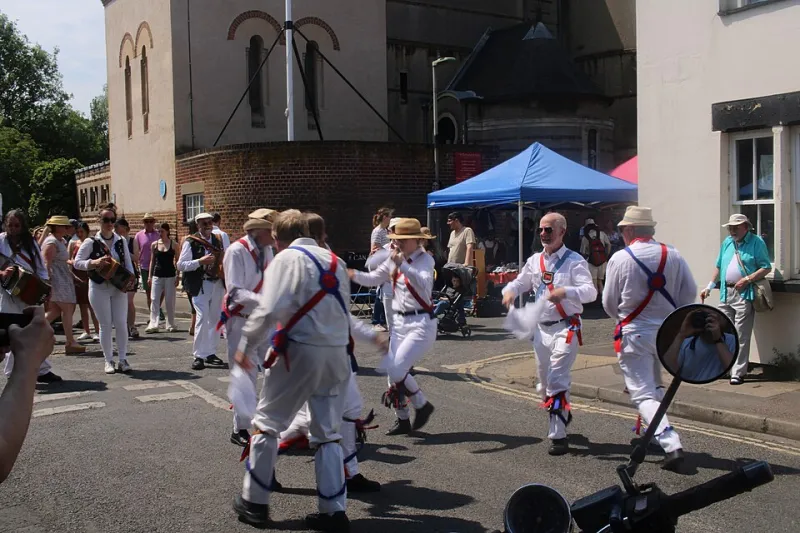
On a Saturday morning in 2026, if you go looking for St Albans Morris Men in St Albans, you might find nothing but empty pavement and a few confused pigeons. That is not a crisis. It is an away day. The side has loaded sticks, bells and a suspicious number of thermoses into a minibus and pointed itself at a market square, village green or pub car park somewhere beyond Hertfordshire.
From the outside, a Morris side's year can look like a series of local performances: Cathedral Green, a summer fete, maybe a Boxing Day stand. From the inside, it is a web of journeys. Sides visit each other. They dance guest sets. They eat pub lunches with people they have known for decades and people they met forty minutes ago. The away day is not a break from the tradition. It is one of the ways the tradition keeps breathing.
The 7:40 minibus test
Away days begin with logistics. Who is driving? Who has the spare bell pad? Has anyone remembered the banner, the collection buckets or the folder of dance notes that nobody has looked at since March? The minibus is not glamorous. It smells faintly of yesterday's kit bag and someone's coffee. But it is where the side becomes a side rather than a list of names on a programme.
Early starts are part of the bargain. A host side has built a day around its own dancers, musicians and local audience, and the guest spot usually sits somewhere in the middle of it. Arriving late, unloading in a panic and dancing breathlessly is not the look. So the side leaves with margin, stops for the inevitable loo break, and arrives in time to find out where to park, where to change and whether the landlord minds bells near the glassware.
What a guest set really means
A guest set is short. That is the point. The visiting side is not there to take over the day; it is there to add a layer. The host side has invited St Albans Morris Men because it wants another set of bells, another musician's ear and another set of dances in front of its local crowd. In return, the guests need to be ready, know the running order and not stretch a twenty-minute slot into a forty-minute epic.
There is an etiquette to this that nobody writes down in full. You thank your hosts properly. You do not complain about the space, the weather or the fact that the afternoon programme has drifted by half an hour, because host sides know all of that already. You watch the host side dance. You clap. You buy something from the raffle if there is one. You remember that you are a guest in someone else's Saturday.
Dancing another side's dance
Morris is full of local versions. A dance that seems familiar in name can have a different step, a different stick pattern or a different way of turning at the end. When a host side invites guests to join in — and often it does — the visitor's job is to follow, not to correct. There is a particular kind of silence that falls when a visiting dancer explains, helpfully, that "we do it differently back home". It is not a silence anyone wants to create.
The better approach is curiosity. Ask which version they use. Watch the caller. Keep your stick low, your bells out of someone's ear and your hankies to yourself unless invited. If you get it wrong, smile and carry on. Morris has survived worse than a misplaced half-gyp.
The pub lunch is not a break from the dancing
It is tempting to treat the pub lunch as the interval between the real bits. In fact, it is where much of the real work happens. This is when visiting and hosting sides talk about next year, about a possible return fixture, about a musician who might be free in June, about a young dancer who is looking for more chances to perform. It is also when the landlord decides whether a Morris side is welcome back.
So the side eats, drinks sensibly and remembers that it is representing not just St Albans but the whole slightly odd, very sociable business of English folk dance. A side that leaves a pub looking like a small weather event has just happened will find its invitations drying up. A side that clears its plates, thanks the staff and buys a round for the hosts will be asked back.
The debt of return
Every away day creates a debt. If St Albans Morris Men visit another side in 2026, the polite assumption is that the favour will be returned. Hosting duties are not complicated, but they matter: a clear programme, sensible parking information, a decent place to change, water for the musicians, a collection for the local cause and a proper thank-you at the end. The best hosts make it look effortless. It is not effortless.
This reciprocity is the quiet engine of the Morris network. There is no central booking office for the UK's sides. There is an informal web of meets, days of dance, festivals and personal invitations. One side knows another, which knows a third, which has a musician whose cousin dances in a border side three counties away. The network is held together by people who answer emails, put the kettle on and remember who turned up for them in the rain.
Why the road matters
A side that never travels can still dance beautifully. But it can also become a little sealed off, dancing the same dances to the same faces in the same square. Away days put St Albans Morris Men in front of new audiences, new musicians and new dancers. They remind the side that its way of doing things is one good way among many. They keep the conversation going.
So if you spot a group of bell-padded dancers unloading a minibus in a town you did not expect, stay for a set. You are watching the tradition at work — not just the dancing, but the travelling, the hosting, the remembering and the returning. Bells, sticks and hankies in Hertfordshire since 1972, yes. But sometimes, quite deliberately, somewhere else.