Cathedral Green, Station Forecourt, Car Park: The Unlikely Spots Where St Albans Morris Men Have Danced

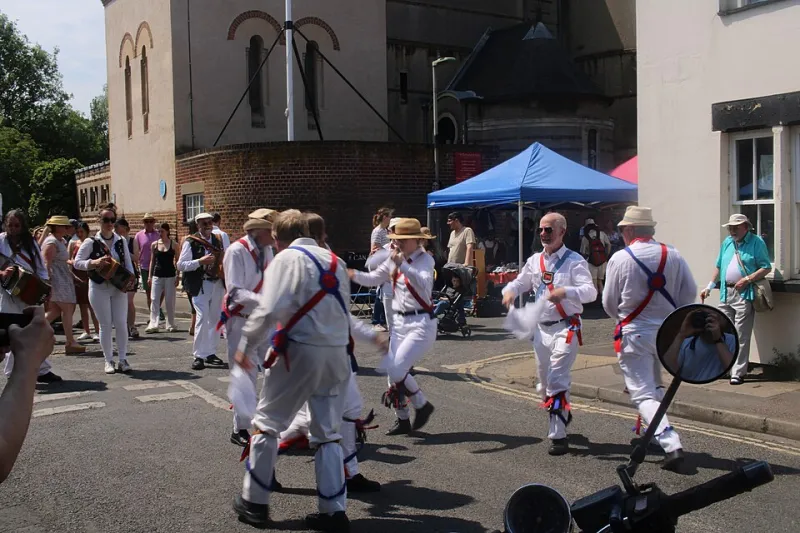
St Albans Morris Men have been dancing since 1972, and in that time the side has performed in more places than most of us have had hot dinners. Cathedral Green is the postcard image, and rightly so. But Morris is a portable tradition. Give us a patch of flat ground, a reasonable surface and a crowd that is at least mildly curious, and the bells will do the rest.
Here is a wholly unscientific tour of some of the less obvious spots the side has turned up in over the years — and what they reveal about dancing in a changing city.
Cathedral Green: the obvious one, and still the best
Let us get the famous one out of the way. Dancing beside St Albans Cathedral is a privilege. The backdrop does half the work, the tourists stop because they were already stopping, and the sound of bells against that old stone is genuinely lovely. It is also the place where people who thought Morris was not for them discover that it is quite good fun to watch.
But Cathedral Green is not the whole story. It is the shop window. The rest of the year happens elsewhere.
Pub yards and back gardens
A good pub yard is Morris gold. It is enclosed, so the sound bounces around, and people are already in a sociable mood. Over the decades the side has danced in yards and gardens attached to pubs in and around St Albans, sometimes with a proper audience and sometimes with three locals and a dog who could not care less.
The pub yard is also where Morris gets closest to its roots. These tunes were not written for concert halls. They were made for rooms, courtyards and streets where the music and the dancing had to compete with conversation. A confined space suits that.
Village greens and the edges of town
Sandridge, Wheathampstead, Redbourn and Harpenden have all had Morris on their doorsteps at one time or another. Village greens are often the most comfortable places to dance: flat, open, usually near a pub or a hall, and full of people who are pleased to see something happening.
The edges of St Albans tell a different story. New housing estates, community centres and school fields have become the modern equivalent of the village green. They may not have the same centuries-old feel, but they have families, dog walkers and children on scooters — which is exactly the sort of audience Morris needs.
Station forecourts and commuter crowds
A station forecourt is not an obvious venue. It is busy, it is noisy, and half the people there are trying to catch a train. Yet St Albans City station and the surrounding streets have a long history of passing trade, and that is oddly suited to Morris.
Commuters do not plan to watch. They stumble across it. Some hurry past with a polite smile. Others stop, phone in hand, and stay for a whole dance. In a city where so many people travel out to work, dancing at the station is a small reminder that St Albans is not just a place to leave in the morning.
Supermarket car parks and festival fields
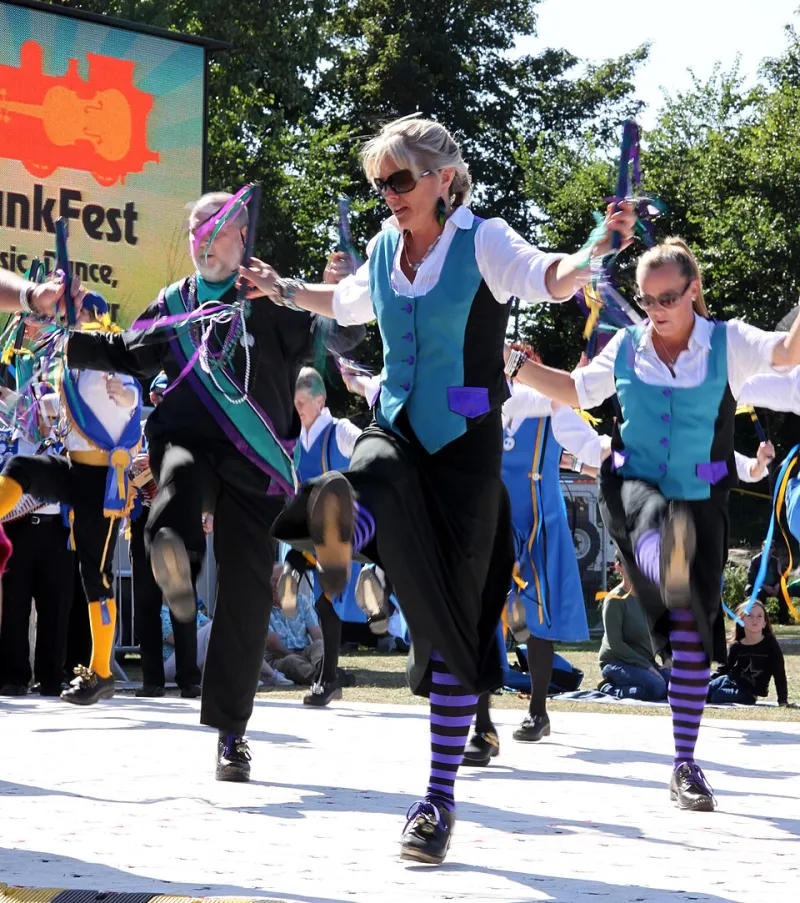
The car park is the great leveller. It is not pretty, it is not historic, and it is often surrounded by trolley bays. But it is flat, accessible and big enough for a set of dancers. The side has danced in supermarket car parks and festival car parks over the years, usually as part of a wider event or a charity collection.
Is it glamorous? No. Does it work? Absolutely. Morris does not need a stage. It needs a clear space and a few people willing to stand and watch. A car park at a summer festival, with families drifting between stalls and the smell of burgers in the air, is as good a place as any to keep the tradition alive.
Why some places make the bells ring better
There is a practical side to all this. Bells sound different depending on what is around them. A stone wall or a pub building can reflect the sound back at the dancers. Open grass can swallow it. A covered market or an arcade can make the whole side sound twice as big.
Ground matters, too. Flat, firm ground lets the dancers move properly. Gravel, slopes, wet grass and loose surfaces are hard work and not much fun. The best venues are the ones where you can forget about your feet and get on with the dance.
And then there is the crowd. A busy street with people going about their business is often better than a seated audience who have come specifically to watch. Morris thrives on surprise.
What the venues say about St Albans
The places the side has danced tell a story about the city itself. The Cathedral and the old pub yards speak to the historic St Albans. The station forecourts speak to the commuter city. The supermarket car parks and new estates speak to the everyday, unglamorous, busy place that most residents actually live in.
Morris has adapted to all of them because it has always been a practical tradition. It turns up, it makes a noise, it invites people in. In 2026 the side is still doing exactly that — on Cathedral Green when the occasion calls for it, and in a car park when that is where the people are.
The next unlikely place
If you see a group of dancers in bells and baldrics somewhere unexpected — a retail park, a station approach, a school playground, a festival field — do not assume they are lost. They are probably exactly where they mean to be. Morris dancing has never needed a perfect setting. It just needs a bit of space and a reason to start.
And if you know a spot in St Albans that deserves a dance, tell us. The side is always looking for the next unlikely place to ring the bells.