The Look Before the Leap: How a Morris Set Stays in Step Without a Shout
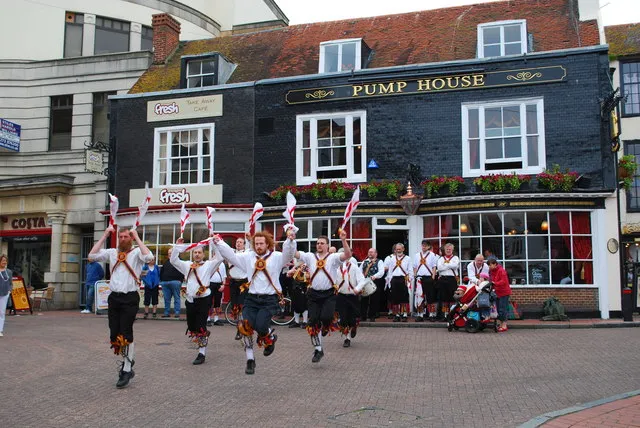
Photo: william, CC BY-SA 2.0, via Wikimedia Commons
Stand near the front at a St Albans Morris Men performance and the first thing you notice is the noise. Bells, sticks, melodeon, maybe a fiddle, and the general chatter of a Saturday morning crowd. What you will not hear much of is talking. Once the music starts, the dancers are already several moves ahead, passing instructions through glances, shoulders and the occasional lift of a hanky.
To a passer-by it can look like cheerful chaos. To the dancers it is closer to a conversation. Not a secret code, exactly — nobody is hiding the rulebook — but a working language built from small, visible signals. It is the sort of thing you only notice once you know where to look.
A Set Is a Conversation
Morris dancing is often described in terms of steps, figures and kit, but the bit that holds a performance together is quieter than that. A set has a shape: dancers opposite each other, corners to watch, a foreman or squire who often acts as the anchor. Within that shape, everyone is constantly checking in.
The check-ins are not theatrical. They are practical. A dancer might catch the eye of the person opposite, drop a shoulder by an inch, or give a barely visible nod before a figure begins. None of that reads as a signal from ten yards away, which is rather the point. The best cues are the ones that keep the dance moving without pulling attention away from it.
This is why a Morris side can look relaxed and precise at the same time. The precision is not coming from a shouted count. It is coming from a dozen small agreements made in the second before the next phrase.
The Cues Hiding in Plain Sight
Ask a new dancer what surprised them most and the answer is often how little is said. The foreman might call a figure, but the music is loud and the words can vanish into the bell noise. So the set relies on what can be seen.
A nod is the simplest cue. It can mean go, change, or wait — context does the rest. A stick tap is punctuation: a way of marking time or letting the next dancer know the phrase is about to turn. Eye contact does a lot of heavy lifting, especially when a dancer is moving into a position they do not usually take. And then there is the hanky.
A hanky lifted high is easy to spot and hard to mistake. A hanky gathered or half-raised is subtler, and that is where the phrase half-hanky comes from. It is not a magic password. It is a visible punctuation mark — a way of saying we are taking the shorter version, or the figure is changing, or hold that thought for half a beat. Dancers learn to read it in the same way you learn to read a friend's expression across a room.
What the Half-Hanky Actually Does
The half-hanky is one of those traditions that sounds more mysterious than it is. In practice, it is a compact signal: the cloth is held differently, the hand comes up at a particular angle, and the dancers who need to see it know what it means. It is less about secrecy and more about clarity at a distance.
This matters because Morris sets are not static. A figure can be extended or shortened depending on the space, the crowd, the ground, or simply the way the music is going. A dancer who misses a change can end up half a beat out, which is not a disaster but is untidy. A quick visual cue keeps the set together without stopping the performance to explain.
Spectators often spot the raised hanky first because it is the most visible part of the grammar. Once you have seen it, you start noticing the rest: the tiny nod before a turn, the stick tapped against a palm, the way two dancers find each other's eyes before a movement that could otherwise go wrong.
Calls Are the Audible Edge
There are calls in Morris, of course. Short words flung over the melody, the kind of thing that sounds like tradition and functions like a sat-nav. But the calls are only one layer. They are the audible edge of a system that is mostly visual.
That is especially true outdoors. On Cathedral Green or a busy city-centre pitch, the melodeon is doing its best, the bells are doing their thing, and a shouted instruction can easily be swallowed. Dancers adapt. They rely on the person opposite, the foreman at the edge, and the shared memory of the dance. The call might start the figure, but the nod and the hanky keep it honest.
How Dancers Learn the Grammar
New dancers do not arrive knowing any of this. They learn it the way most people learn a dialect: by standing in the middle of it, making mistakes, and gradually tuning in. Practice nights are where the cues are slowed down and repeated. A foreman might walk a new dancer through a figure, then run it again with the music on, then again with the set moving around them. The nod that was invisible in week one becomes obvious by week six.
St Albans Morris Men have been dancing in Hertfordshire since 1972, and the side has always depended on this kind of hand-me-down knowledge. Nobody is handed a manual of secret signals. Dancers watch, copy, ask questions after the set, and slowly build up the instinct for when a glance means go and when it means wait. It is one of the reasons the side is keen to welcome newcomers: the grammar only stays alive if people keep using it.
What to Watch For on the Day
If you are watching a set this year, try following one dancer rather than the whole side. Watch their eyes before a figure starts. Look for the small nod, the shoulder turn, the stick tap that lands a fraction before the music changes. Then watch the hanky. A raised cloth is the easy cue; a gathered one is the interesting one.
You will not decode everything, and you do not need to. The pleasure is in noticing that the dance is not just steps and bells. It is a group of people paying attention to each other in real time, often without a word being heard over the tune. That is the real language of a Morris set — and once you have spotted it, you will see it everywhere the bells are ringing.