The Gym Floor Is the New Village Green: Morris Dancing Goes Back to School
Photo: Internet Archive Book Images, No restrictions, via Wikimedia Commons
On a wet Tuesday morning in October, the loudest thing in a St Albans primary school gym is not the children. It is six pairs of bell pads, a melodeon, and the moment thirty Year 4 pupils realise they are allowed to make a noise.
This is one of the school and community workshops in our 2026 programme. We are not there to stage a polished performance or to dress up as a piece of local history. We are there to teach a simple stick dance, explain why the bells matter, and let a gym floor become a village green for forty-five minutes.
Forty-Five Minutes, Start to Finish
We arrive early. Not because Morris dancers are naturally punctual, but because a school hall has to be checked, chairs moved, sticks laid out and a melodeon coaxed into tune. By the time the caretaker unlocks the door, we have carried in a box of short ash sticks, a bag of hankies, a bundle of bell pads and a portable speaker that never gets used because the real instrument is louder.
At 9.05, the children file in. We start with a march and a clap — no explanation, just a rhythm to copy. That is deliberate. Before anyone has to understand what Morris is, they have already done a bit of it.
The first five minutes are names, a quick show-and-tell and one honest question: what do you think Morris dancing is? The answers range from “people with bells” to “is it like ballet?” to a very confident “my nan does it”. All are accepted.
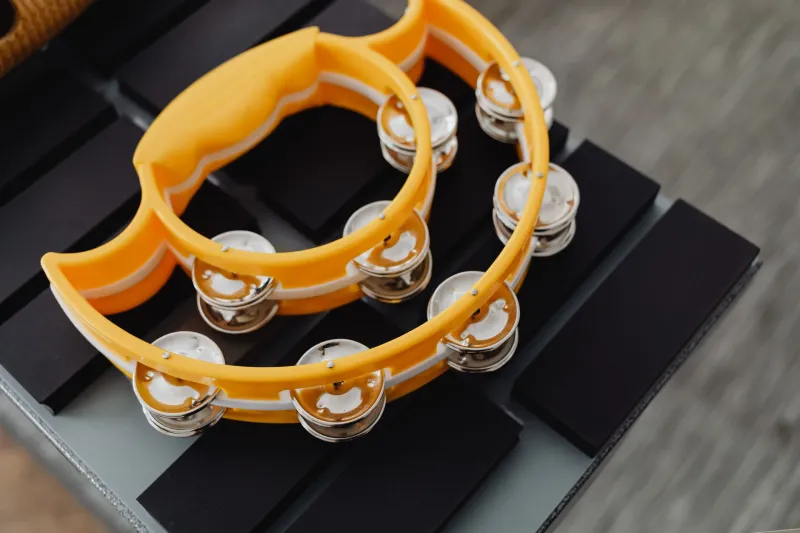
Next comes the rhythm. We hand out wrist bells for the taster session — easier than buckling shin pads onto small legs — and teach a slow stamp-clap pattern. Then we add the sticks. Two lines, a count of eight, tap your own stick on the floor, tap your partner’s stick gently, step right, step left. The instruction that gets the biggest laugh is always the same: “Gentle taps, not sword fights.”
For the last fifteen minutes we bring out the hankies. Waving, skipping, making a gate for another pair to pass under. It looks chaotic for about ninety seconds, then something clicks and the lines begin to hold. We finish with a mini performance for the class teacher, who is usually filming it for the school newsletter before we have even asked.
The final five minutes are questions. Are the bells heavy? Not very. Do we get paid? Sometimes, but not for this. Why do we do it? Because somebody did it for us.
Why Bells Belong in a Gym
There is a temptation to treat folk traditions as fragile things. Put them in a display case, label them carefully, ask people to admire them from a distance. That approach kills them.
Morris dancing has survived because it has been useful: a way to mark a season, raise a glass, collect for a cause, or simply get a street moving on a Saturday morning. If it only exists on a stage or in a heritage leaflet, it stops being a living tradition and becomes a museum piece.
A school gym is not a glamorous setting. The floor is marked with netball lines, the walls are covered in PE rules, and there is always a faint smell of school dinners. That is exactly why it works. Children learn that Morris does not need a perfect green or a fancy festival. It needs people, a beat and a bit of floor space.
The bells are not decoration. They are a shared clock. When thirty children are wearing bells and trying to move together, they can hear whether they are in time. Sticks teach timing and trust — you have to tap your partner’s stick, not their knuckles. Hankies teach line and space; you have to know where your neighbour is without staring at them.
None of that needs a lecture on intangible cultural heritage. It needs a stick and a count of eight.
The Museum Trap
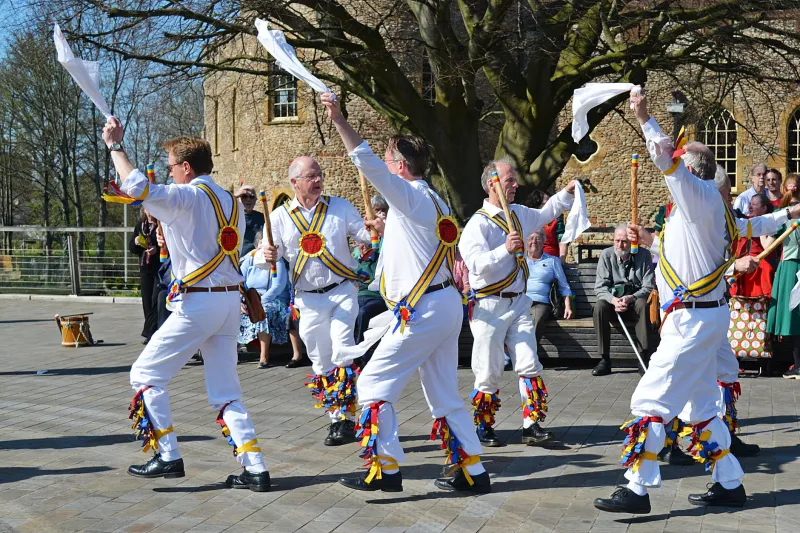
We are careful not to turn the session into a fancy-dress parade. We wear our kit, because the bells and ribbons are part of the dance, but we do not ask for hushed reverence. We explain that Morris is not one thing. There are different styles, different tunes and different ways of doing it. Ours is a Cotswold-style side with sticks and hankies, and it has been part of St Albans since 1972.
We also explain that traditions change. The dances have been passed on, adapted and argued over for generations. That is a feature, not a bug. A tradition that cannot change is already finished.
The best feedback is rarely applause. It is a child asking whether they can try the melodeon. It is a teacher saying they had no idea Morris was so physical. It is a parent emailing a week later to ask where they can see us dance at the weekend.
The Practical Bits
School workshops are not complicated, but they do need care. The adults are DBS-checked, the side carries insurance, and we work with the school’s own risk assessment. We use shorter, lighter sticks for children. We keep the session to forty-five minutes because that is about as long as concentration lasts when bells are involved. We give shy children jobs — bell collector, door holder, musician’s assistant — so nobody has to dance if they would rather not.
The aim is not to create thirty new Morris dancers by home time. The aim is to plant a small, noisy seed: this exists, it is for you, and it is not as strange as you think.
If Your School Wants a Turn
Our 2026 programme includes school visits and community workshops across St Albans and the surrounding villages. If you are a teacher, scout leader, care home activities coordinator or parish event organiser, you can get in touch through stalbansmorrismen.org.uk. We bring the sticks, bells, hankies and questionable jokes. You bring the floor and a sense of humour.
The gym floor will never be a village green. But for forty-five minutes on a wet Tuesday, it can sound like one.