Fifty-Four Years of Saturday Mornings: How St Albans Morris Men Keep the Dance Alive
St Albans Morris Men have been part of Hertfordshire’s weekends since 1972. That’s 54 years by 2026 — long enough to span six decades, several generations of dancers, and an awful lot of pub car parks. The side is not a museum exhibit. It’s a working folk group that rehearses, books gigs, argues about sticks, welcomes newcomers and turns up on cold mornings because that’s what the calendar says.
That longevity is worth thinking about. Plenty of folk groups start with enthusiasm and fade when the founding dancers move away, get injured, or discover that running a side involves more admin than anyone advertised. St Albans Morris Men have not just survived; they’ve kept a visible presence in a city that is better known for Roman ruins, commuter trains and a very impressive cathedral. So what has kept the bells ringing?
From 1972 to 2026: a side shaped by its patch
The side was founded in 1972, in the middle of a broader folk revival that saw morris dancing take root in towns and cities across England. St Albans was a natural home for it. The city has a strong sense of local identity, a busy pub culture, and a habit of holding on to slightly eccentric traditions. Morris fitted right in.
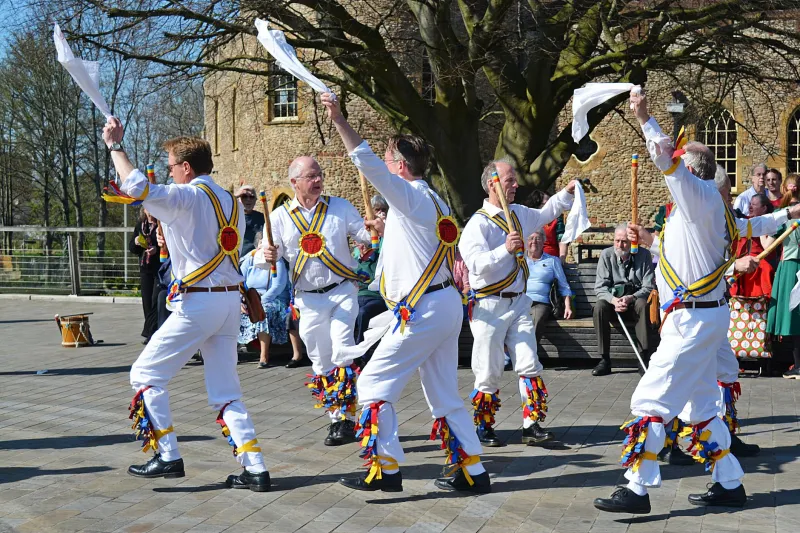
In the early years, the side would have been a familiar sight at pub yards, village greens and local fetes. The repertoire would have been built around Cotswold-style dances, with bells, sticks and hankies, and a musician or two keeping the whole thing together. Over the decades, the side has danced at festivals, wassails, May Day events, beer festivals, wedding celebrations and, of course, Boxing Day tours. The constants have been simple: a squire to call the dances, a musician to keep time, and a group of people willing to stand in a public place and do something a bit unusual.
That consistency matters. A side that appears once a year is a curiosity. A side that appears regularly becomes part of the furniture. St Albans Morris Men have managed the second trick. They are recognisable, but not frozen. The dances may be traditional, but the people, the venues and the audiences have changed.
Tradition is not the same as standing still
One of the most useful lessons from 54 years is that tradition survives by being performed, not preserved under glass. Morris dancing is often described as ancient, and parts of it certainly are. But a living side has to make decisions every year: which dances to keep, which to teach, where to perform, how to explain itself to people who have never seen a hanky dance in their lives.
St Albans Morris Men have balanced that by keeping the core craft intact while staying open to the practical stuff. You still need good timing, clean stepping and a decent musician. You also need a website that works, a diary that doesn’t double-book, and a way of telling the pub landlord what time you’ll arrive. Tradition and admin are not opposites. They are housemates.
That balance is worth copying. Folk groups that cling to the past without explaining it can become inward-looking. Groups that chase novelty too hard can lose the thing that made them distinctive in the first place. The sweet spot is a side that knows what it is, can explain why it matters, and is willing to change the bits that don’t affect the dance.
What 54 years has taught us about recruitment
Ask ten dancers why they joined and you’ll get ten answers. Some come for the exercise. Some come for the friendship. Some come because they saw a side in a pub garden and thought, “That looks like fun.” Others come because they want to connect with a local tradition, or because they’ve moved to the area and need a Saturday morning that isn’t spent unpacking boxes.
The lesson is not to assume there is one kind of recruit. The best recruitment tool is a visible, happy side. A group that looks like it’s enjoying itself is far more persuasive than a poster asking for new members. Open practice nights, taster sessions and word of mouth all help, but they work best when the side is already out there being seen.
It also helps to make the first step easy. A newcomer should know where to go, what to wear, and whether they need to bring anything. They should be greeted, introduced, and given something simple to try. If the first night feels like an audition, they won’t come back. If it feels like a bunch of people who are glad you turned up, they might.
The local audience is the long game
St Albans Morris Men have never been a remote, festival-only outfit. They dance in the places where people already are: high streets, pub gardens, community events, local festivals. That visibility is not just nice to have. It’s the thing that keeps a folk group relevant.
A side that only appears at specialist folk events is easy to forget. A side that turns up outside the local on a Saturday afternoon becomes part of the town’s texture. That means saying yes to local bookings, building relationships with venues and councils, and being willing to explain what’s going on. It also means accepting that not every audience will know the difference between a handkerchief dance and a stick dance — and being happy to tell them.
Community performances are also a two-way street. The side gets an audience, a reason to rehearse and a bit of money in the collecting tin. The audience gets something free, local and a bit different. In a commuter city like St Albans, where plenty of people arrive without family roots in the area, that kind of shared experience is worth more than it looks.
The unglamorous bits matter
Fifty-four years is not built on bells alone. It’s built on insurance, first aid, kit storage, accounts, booking confirmations and someone remembering to bring the spare sticks. Every long-running folk group has a hidden layer of admin, and the sides that last are the ones that take it seriously without letting it take over.
Good records help. So does a treasurer who actually enjoys the job. So does a clear way of welcoming new people and a rota that doesn’t rely on the same three dancers every week. These are not exciting topics, but they are the difference between a side that survives a bad winter and one that folds because nobody can find the collection buckets.
Why Morris still matters on Hertfordshire high streets
In 2026, it’s easy to feel that most entertainment is delivered through a screen. Morris dancing is the opposite. It’s live, it’s local, and it asks you to stand in the cold for a few minutes and watch other people do something together. That’s a small but genuine form of community.
It also connects the present to the past without being heavy about it. The dances are traditional, but the performance is happening now, for whoever happens to be walking past. A child watching bells for the first time, a dog walker stopping to take a photo, a pub regular nodding along from the doorway — they’re all part of the same thing. The side isn’t performing at them. It’s performing among them.
After 54 years, St Albans Morris Men have earned the right to be a little proud of that. But the real lesson is simpler: keep turning up, keep explaining, keep welcoming, and keep the bells in good repair. That’s how a folk tradition stays alive on a Hertfordshire high street — one Saturday morning at a time.