A Semicircle, Not a Barricade: Reading the Living Crowd Around a Morris Set

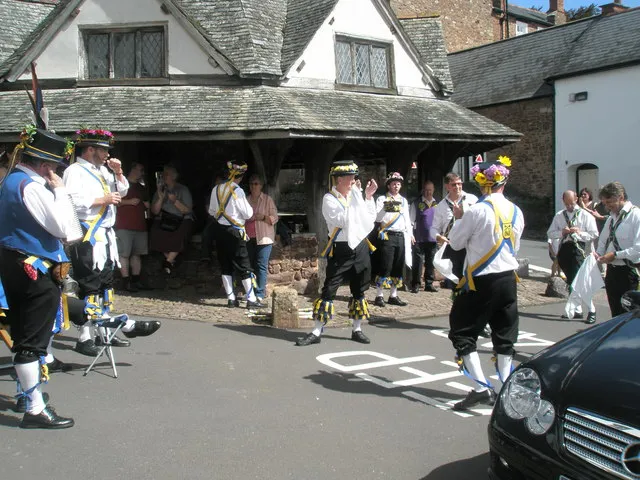
Morris dancing is often described as a performance. Anyone who has spent ten minutes on a market square knows it is closer to a conversation. The side brings tunes, sticks and bells; the crowd brings dogs, prams, pint glasses and unpredictable questions. Between the two forms a living semicircle — rarely neat, never quite still, and governed by rules nobody has written down.
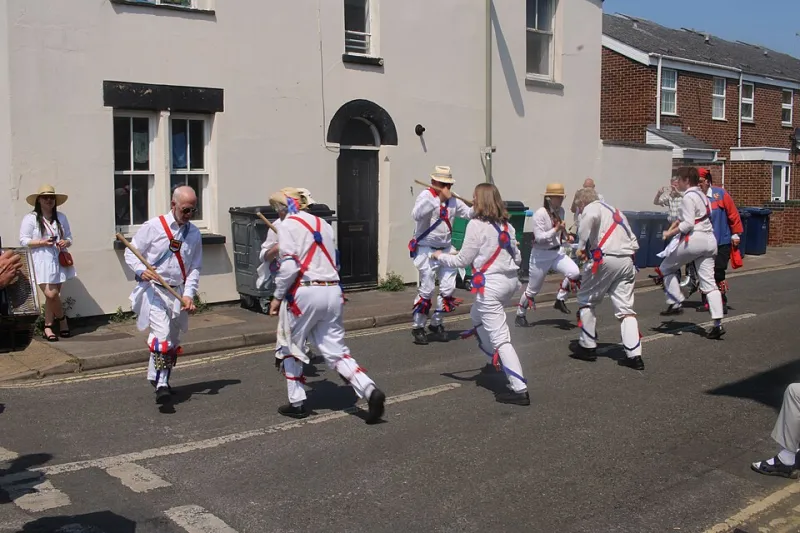
St Albans Morris Men have danced on Cathedral Green, outside pubs, in car parks and on station forecourts since 1972. The backdrop changes; the semicircle does not. Here is a field guide to the people who gather, plus a few thoughts for organisers who want the dancing to stay spontaneous without turning the pavement into an obstacle course.
The front row is never empty for long
Small children operate on a simple principle: if there is a gap, fill it. A toddler who has never seen a Morris side before will usually spend the first minute staring, the second minute copying the footwork, and the third minute trying to join in. Dancers learn to spot the exploratory shuffle early. A smile and a quick sidestep are usually enough; a firm word to a parent is not, because the parent is often the one holding the pint.
Buggy pushers deserve a special mention. A pram is a wonderful viewing platform and a terrible dance floor. The trick is to leave a generous edge to the set — enough room for a child to see, not so much that the front row drifts into the sticks.
Pint glasses are part of the choreography
Every Morris dancer has performed beside a spectator holding a full pint at chest height. It is a fine balancing act. The glass is not a prop, and it is certainly not an invitation to demonstrate a hand-clapping sequence. The unwritten rule is simple: give the drinker a metre, catch their eye before turning, and never swing a stick towards anyone who is not expecting it.
For organisers, the kindest thing is a little forethought. If the pub has outdoor tables, ask whether they can be shifted to create a natural edge. If not, a steward or two can quietly suggest that the front row stands back when the sticks come out. No barriers, no tape, no announcement over a megaphone. Just a bit of gentle geometry.
Dogs have their own agenda
Dogs attend Morris events in three categories: the enthusiast, the sceptic and the completely uninterested. The enthusiast wants to sniff every bell pad and will attempt to join the set. The sceptic will bark at the first clash of sticks and then settle under a bench. The uninterested dog will sleep through the whole thing, which is its own form of criticism.
Owners know their animals. Dancers should ask before approaching, especially with bells and sticks. A bowl of water and a shaded spot do more for crowd safety than any amount of signage. And if a dog decides the only sensible place to sit is in the middle of the set, the set moves. That is not defeat; it is local diplomacy.
The cyclist who will not dismount
There is always one. The cyclist approaches the edge of the crowd, assesses the situation, and decides that the most efficient route home is directly through the dance. Dancers can see it coming. The cyclist can see the dancers. Neither party wishes to lose face.
The best response is calm and early. A steward or dancer can step forward, make eye contact and gesture to a clear path around the set. No shouting, no dramatic arm-waving. Most cyclists are happy to go around once they realise the alternative is a close encounter with a stick. If they are not, let them through and restart. A Morris side that stops for thirty seconds loses nothing; a confrontation can ruin the afternoon.
Reading the crowd is a dancer's skill
A good set does not just perform at the crowd; it adjusts to it. If the front row is full of toddlers, the sticks might stay lower and the hankies come out earlier. If the audience is three deep and holding drinks, the side widens the circle. If a camera lens appears, the dancers know to hold the pose for half a beat longer. None of this is scripted. It is the equivalent of a band watching the room.
This is why the best audiences are never quite still. They lean, point, clap in the wrong place and ask questions during the music. They are not a backdrop. They are part of the rhythm.
What organisers can do without over-organising
The instinct at any public event is to control everything. Resist it. A Morris set does not need a fenced enclosure. It needs a sensible amount of space, a clear entrance and exit, and someone who can answer questions without making the crowd feel managed.
Useful things include a steward who knows the running order, a safe route for buggies and wheelchairs, and a word with nearby businesses about expected footfall. Less useful things include rope barriers, stern announcements and a compere who fills every silence. The semicircle forms itself. Your job is to stop it forming in the road.
The unwritten rules, briefly
Give the dancers room. Keep drinks at a safe height. Ask before petting the dog. Let the cyclist through. Let the toddler dance at the edge. Clap when you like. Ask questions after the set, or during if you must — the dancers are used to it. And if you are not sure whether you are standing too close, you probably are.
St Albans Morris Men have been gathering crowds since 1972, and the crowd has never been the problem. It is the reason the bells are worth ringing. A semicircle is not a barricade. It is an audience, a safety zone and a community, all at once. Keep it loose, keep it kind, and everybody gets to enjoy the dance.