Bells, Sticks and Hankies: A Field Guide to Reading a Morris Side's Kit
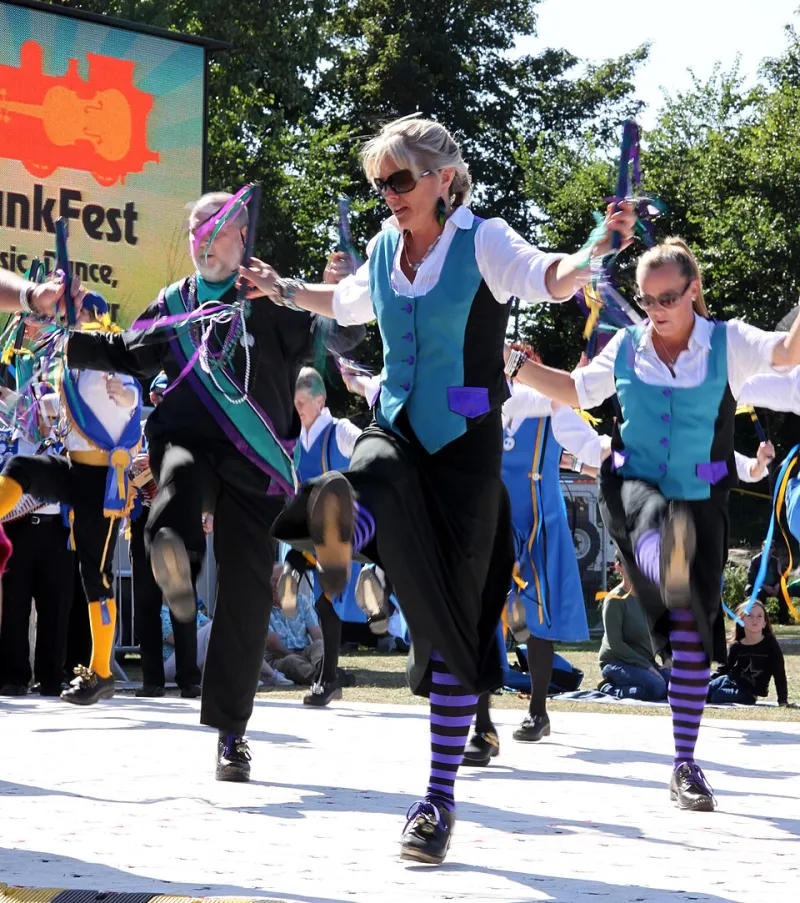
Photo: Mike Finn, CC BY 2.0, via Wikimedia Commons
There's a moment at nearly every public stand when someone in the crowd turns to whoever they came with and asks a quiet question. Usually it's about the bells. Sometimes it's about the sticks, and whether anyone actually gets hit. Occasionally it's about the hankies, and why grown adults are waving them about on a Saturday morning outside the Abbey.
Fair questions, all of them. Morris kit looks peculiar at first glance because it wasn't designed to be inspected from a distance by strangers. It grew up over centuries as workwear, festival wear and a certain amount of showing off, layered together and handed down. Once you know what each piece is doing, a stand stops looking like a jumble of ribbons and starts looking like a conversation.
Here's the short version, written for anyone who has ever paused on the pavement and wondered.
Bells: the oldest sound system in England
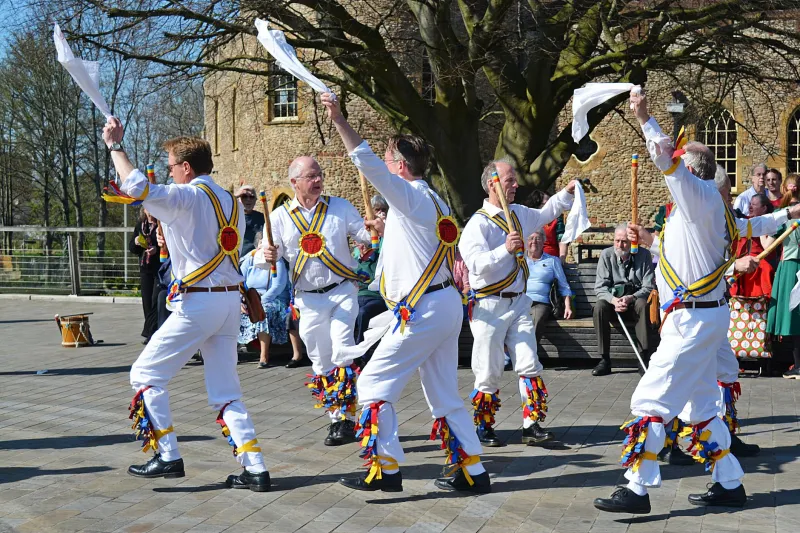
Bell pads are the loudest part of the outfit and the easiest to explain. They're straps of leather or cloth, buckled around the shin just below the knee, and each one carries a row of small brass bells. Some sides wear them at the ankle, a few at the wrist, and the number and size of bells varies enormously from one tradition to the next.
Functionally, they're a percussion instrument you carry on your legs. In the Cotswold traditions that most people picture when they hear the word 'Morris', the step and the bell strike land together, which is why a good side sounds crisp rather than clattery. Stand thirty yards away and you can still hear the beat. That's the point: the bells were amplification before electricity existed.
There's folklore attached too, of course — bells as noise to see off the dark half of the year, bells to announce that something was happening. Take that as you like. What's certain is that they make a side audible before it's visible, which is why you can often hear us coming up French Row before you can see us.
Sticks: rhythm you can hear across the street
Sticks are not weapons, whatever the hecklers say. They're claves with a Gloucestershire accent: short lengths of wood, traditionally hazel or ash, clashed together on the beat to mark the structure of a dance. The clack is sharp, dry and remarkably carrying, and it gives a side a second percussion line underneath the bells.
Lengths vary by tradition. Some dances use short sticks held in one hand, some use longer staves, and some use no sticks at all — longsword and rapper sides carry swords instead, while other traditions favour nothing but hands and hankies. If you see a dancer tapping a stick against a neighbour's stick rather than against a tree, that's the whole idea: the sound is a partnership.
Hankies: the quiet item that says the most
A hanky is a small flag. That's the simplest way to think about it. Held between finger and thumb and flicked outward, a square of cotton or silk extends the line of the arm and makes a movement readable from twenty paces away. Without them, half the elegance of a Cotswold dance — the slow sweep, the turn of the wrist — would vanish into the general noise.
Sides often use hankies in their own colours, and some use them only in certain dances. Watch for it: when the hankies come out, the stepping usually gets more fluid and less percussive. If you're following along at home, this is the visual difference between a stick dance and a hanky dance, and it's the fastest way to spot a change in the programme.
Baldricks, badges and the colours of a side
Crossed sashes over the chest — baldricks, if you want the proper word — are the main way a side declares who it is. Add a waistcoat, a rosette, a flowered hat or a particular shade of ribbon and you have a uniform that identifies the team from a distance.
The badge matters most. Sides guard their badges; they're worn on the sash or the waistcoat and often carry a date, a place name or a bit of local heraldry. In effect it's a family crest, and if a dancer is wearing someone else's badge, there's usually a good story behind it.
What our own kit says about 54 years of Saturdays
St Albans Morris Men have been dancing since 1972, and our kit has changed less than you'd expect. White shirts, dark trousers, bell pads and the side's crossed baldricks: practical clothing that can be washed, mended and worn comfortably for a full day of stands. Over the decades there have been variations — a different shirt here, a new badge there, a rethink about hats — but the principle has stayed the same. The kit should never get in the way of the dancing.
Ours is worn, in the literal sense. Bell pads get re-leathered. Baldricks get repaired. Some of what you see on a Saturday has been in the side's possession longer than some of the dancers have been alive, and there's a quiet continuity in that which no new uniform could buy.
What's actually in the bag
If you've ever wondered what a Morris man carries to a stand, the honest answer is less romantic than the outfit. A typical kit bag holds: bell pads, spare laces, two or three sets of hankies, a stick, plasters, a safety pin or two, a bit of string, a bottle of water and — in colder months — a flask. There is always one item missing, and it is always the one somebody swears they packed.
Five things to look for next time
- The bells tell you the beat.
- The sticks tell you the structure of the dance.
- The hankies tell you the style.
- The badge tells you which side you're watching.
- The hats usually hint at the tradition.
Put those five together and a stand becomes legible in about ninety seconds.
Come and have a closer look
You don't need to know any of this to enjoy a dance, and nobody will quiz you on it. But if you do stop and watch this year, come and say hello afterwards — we're happy to explain the bells, hand over a stick so you can hear the clack for yourself, and tell you where our practice nights are held. Several of us turned up to watch once, asked exactly the same questions, and never really left.