Ales, Sticks and Late-Night Singing: What to Expect at a Morris Ale in St Albans
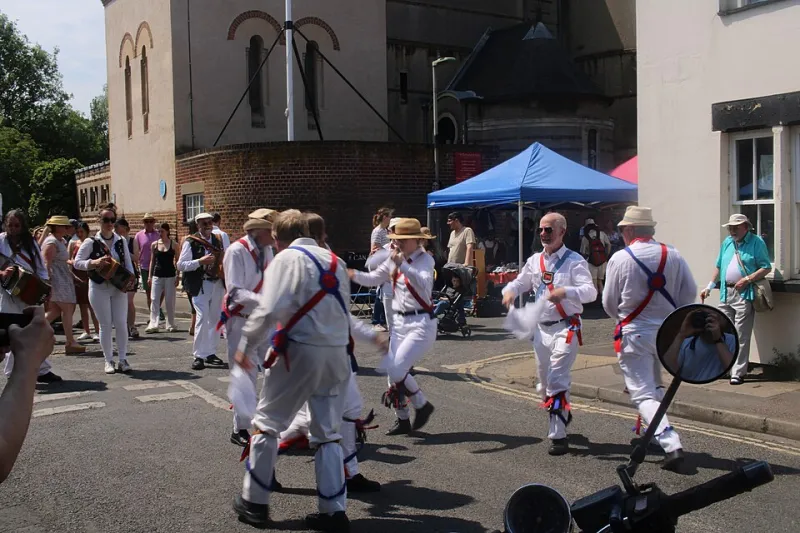
Photo: Bryan Ledgard via Flickr, CC BY 2.0, via Wikimedia Commons
If you've seen Morris dancing in St Albans, chances are it was a summer evening outside a pub or the Boxing Day gathering. Both are excellent introductions. But neither is quite the full picture — because the beating heart of the UK Morris calendar is the ale, and if you've never been to one, the whole concept deserves a proper explanation.
Here's what an ale actually is, what happens over the weekend, and how to behave if you find yourself swept up in one.
First things first: an ale is not really about the beer
The name is older than the modern drinking association. In folk tradition, an ale was a gathering — a feast, a do, an occasion when a community got together, ate well and made a night (or a weekend) of it. Morris sides borrowed the word and made it their own.
In practice, a Morris ale is a weekend when one side hosts visiting sides from across the country. The hosts organise the dancing, the food, the accommodation and the evening entertainment. The guests turn up, dance their hearts out, sing until the early hours and go home with new friends and sore calves. Some ales are small and local; others draw sides from several counties. Either way, the format is remarkably consistent.
Friday evening: arrivals, handshakes and the first stand
The weekend usually opens with people trickling in from Friday afternoon onwards. Cars pull up loaded with sticks, baldricks, instruments and carrier bags of spare kit. There's a certain amount of standing around in pub car parks saying hello to people you haven't seen since last year's ale.
Before long, there's a first stand — often a short, informal set at a local pub to warm everyone up. It's deliberately low-stakes. Nobody's judging the footwork; it's a chance for the host side to welcome people, for visiting dancers to stretch their legs after a long drive, and for the musicians to work out who's playing what for the rest of the weekend.
Saturday: the main event
Saturday is why everyone came. Expect a full day of dancing, usually structured as a series of stands around the town. In St Albans that might mean the market square, the Abbey Gateway, a couple of pubs, and a spot with a bit of grass where the side can spread out. Sides often rotate between locations so there's always something happening somewhere.
A few things you'll notice as a spectator:
- The different styles. Visiting sides may dance Cotswold, Border, North West or something else entirely. Kit varies wildly — from crisp white shirts and bell pads to raggedy coats and blacked-up faces, depending on tradition.
- The music. Some sides bring a single melodeon; others arrive with a fiddle, a concertina, a drum and occasionally something nobody can immediately identify.
- The constant renegotiation. A Saturday ale involves a surprising amount of logistics happening in real time — who's dancing next, where, for how long, and whether anyone remembered the collection bucket.
It's loud, slightly chaotic and enormous fun. If you're in town on the day, you won't be able to miss it.
Hospitality: the part nobody puts on a poster
Ask anyone who's been on the Morris circuit for a while what makes a good ale, and they won't say the dancing. They'll say the hospitality.
Hosting sides put visitors up in spare rooms, on sofas and occasionally in whatever space is available. There's tea. There's cake. There are cooked breakfasts served by people who've been up since six. Guests are ferried between venues, fed, watered and pointed towards the nearest cash machine.
This isn't incidental. It's the entire point. A side that hosts well will be invited back for years; a side that hosts badly will be talked about in car parks for a decade. Hospitality is how the network holds together.
The feast, the speeches and the singing
Saturday evening usually brings a sit-down meal — a proper feed, often in a village hall or a pub function room, with long tables and far too many chairs squeezed in. There are speeches. There may be a raffle. Somebody presents a small trophy or a bottle to the side that travelled furthest.
Then the tables get pushed back, the instruments come out, and the ale turns into a singing session. This is where the weekend's reputation is really made. Songs are swapped — some old, some rude, some unexpectedly beautiful — and a good session can run well past midnight, with the last few singers standing around one fiddler who's refusing to stop.
If you're a non-dancer who's been invited along, this is often the highlight. Bring a song if you have one. Nobody will mind if you don't.
Sunday morning: the quietest stand of the weekend
Sunday tends to be gentler. There's usually a final stand somewhere — often somewhere slightly out of town, a park or a village green — with fewer dancers and a noticeably slower tempo. Then there are goodbyes, promises to come to next year's do, and a slow dispersal of cars packed with slightly damp kit.
The hosts are left with a hall to clean, a mountain of washing-up and the quiet satisfaction of a job done properly.
If you're coming along for the first time
A few practical notes for locals who fancy watching a stand or joining the evening:
- Check timings before you set out. Ale schedules shift during the day. Follow the hosting side's social media for the running order.
- Wear comfortable shoes. You'll be standing, walking between venues, and possibly joining in a dance you don't know.
- Ask before photographing. Most dancers are delighted, but ask, especially with children in the crowd.
- Buy a raffle ticket. It's tradition, and it goes towards the cost of the weekend.
- Stay for a drink afterwards. The dancing is the show; the pub is the actual event.
Why the ale still matters
Morris in the UK survives on a surprisingly thin infrastructure: a few hundred sides, a shared repertoire, and a tradition of visiting. The ale is where all of that gets renewed. It's how new dancers meet the wider scene, how musicians find each other, and how a side's reputation is built one cup of tea at a time.
So if you hear that St Albans is hosting visiting sides this year, don't treat it as a curiosity. Come down, watch a stand, buy a drink, and find out why people drive four hours for a weekend of this.