Mend, Learn, Plan, Repeat: Inside a Morris Side's November
There's a particular kind of quiet that settles over St Albans in the second week of November. The Cathedral clock still chimes, the market still sets up on Wednesdays and Saturdays, but the streets have that damp, hunkered-down feel that arrives the moment the clocks go back. If you only ever see Morris dancing in the sunshine — on a bank holiday green, outside a pub in Harpenden, or on the forecourt by the station — it would be easy to assume the side has gone into hibernation.
It hasn't. November is one of the busiest months we have. It's just that almost none of the work happens in public.
The kit box tells the truth
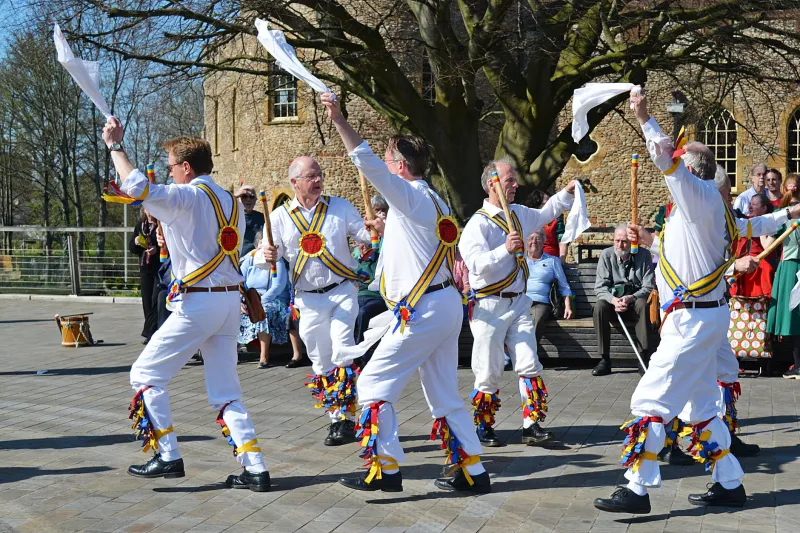
Morris kit looks cheerful and slightly indestructible: bell pads, baldrics, waistcoats, hats, and enough white handkerchiefs to stock a small wedding. In reality it's a collection of small, fiddly objects that take a hammering over a season, and by November the accumulated wear is obvious.
So the first job of the month is a slow, sociable repair session. Bells get checked for missing or seized clappers. Leather pads get re-stitched or, occasionally, retired with a small ceremony and a rude word. Sticks are sanded back and given a fresh coat of something protective, or sorted into two piles: good for dancing, and good for firewood. Waistcoats are washed, buttons reattached, and the perennial question of who has somehow ended up with three spares is raised again.
It is not glamorous. Nobody has ever asked for a photo of a man with a needle and a tin of beeswax. But a side that doesn't look after its kit in November is a side that loses bells in April, and there's a real satisfaction in putting a box away in better order than you found it.
New dances, old arguments
Practice nights carry on right through the winter, and November is when the serious learning tends to start. The summer repertoire is set by spring — nobody wants to be taught a new figure the week before a wedding booking — so the darker months are when we're allowed to be clumsy again.
Some of that is revisiting dances the side has let slip for a year or two. Some is adding a new tune to the long list of Border and Cotswold material in the book, or reworking a figure that has never quite sat comfortably. Every side has a handful of dances that are 'nearly there' — the ones where the stepping is right but the timing sags, or where two people always end up in the wrong place and blame each other cheerfully.
This is also when newer members get the most attention. In June a beginner is thrown in at the deep end out of necessity; in November there's time to walk through a whole dance slowly, without a crowd watching, without a pub garden to fill. If you have ever thought about giving Morris a go, the workshop months are genuinely the best window — you can arrive with two left feet and nobody will mind.
Filling next year's diary
Anyone who has watched a side dance and assumed it all just happens would be surprised by the admin. Bookings for fetes, weddings, beer festivals and village days arrive throughout the year, but a big chunk of the planning for the following spring and summer lands in late autumn, when organisers start thinking about their own calendars.
That means emails, phone calls, and a few careful conversations about what a side can realistically do on a given Saturday. It means agreeing which charities the collection bucket will support, since almost every public dance we do raises money for someone. It means working out how several dozen people with jobs, families and unreliable knees can be in Redbourn at eleven and Sandridge at two without anyone sprinting across the district in kit.
The result is a diary that slowly fills with the names of Hertfordshire villages, church fetes and long-standing pub landlords. By February it looks like a proper season again.
Keeping the social thread
Morris sides are, underneath the sticks and bells, just a group of people who like each other's company. That side of things needs feeding too. Winter is when the side tends to see more of itself off the dance floor: the pub nights, the occasional walk, the long, unhurried conversations that don't have to compete with a melodeon.
This matters more than it sounds. A side that only meets to perform is fragile. A side that meets to mend sticks, argue about a hornpipe and eat too many chips is one that will still be ringing bells in another fifty years. St Albans Morris Men have been going since 1972, and the reason has never been the dancing alone.
Then, quite suddenly, it's December
All of this — the repairs, the practice, the planning, the mild squabbling over a figure that has never quite worked — builds towards the moment the side appears in public again. For most people in St Albans that moment is Boxing Day, when the bells come back out and the streets fill with people who have no idea they were missing anything.
So if you see a Morris man in November and he looks as though he's doing very little, be kind. He may be sanding a stick, learning a new tune, or quietly deciding who to email about a booking in June. The dancing is only the bit you can see.
If you'd like to be part of the workshop months — as a dancer, a musician, or simply someone who fancies a pint and a bit of English tradition — our winter practice nights are the friendliest door in. Details and contact information are on the website, and the side is always glad to hear from curious neighbours, whether you live around the corner from the Cathedral or out towards Wheathampstead.