Flick, Fold, Flourish: The Unexpected Language of the Morris Hanky
On a damp Tuesday in November, the practice hall in St Albans smells faintly of rope-soled shoes and rain. A plastic box sits open on a chair near the door. Inside are dozens of white handkerchiefs, some ironed into neat quarters, others crumpled from last season. To a newcomer they look like a laundry accident. To anyone who has stood in a Morris set, they look like punctuation.
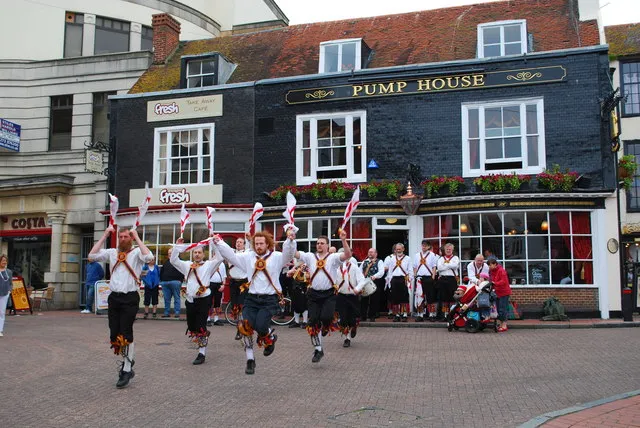
The hanky is the quietest piece of kit in the side. Sticks make a noise. Bells announce arrival. The hanky does neither. It simply draws lines in the air and makes the dancer's arm look longer, looser and more deliberate. As St Albans Morris Men look ahead to Boxing Day 2026 and another year of dancing on Cathedral Green, station forecourts and the occasional muddy fete field, it is worth asking how a square of cotton became one of the most expressive things a dancer carries.
A Square with a Longer Story Than the Dance
The handkerchief's history is older than any documented Morris tradition. In medieval and early modern Europe, fine cloths were carried at court and in church, used for wiping hands, covering the head, signalling status and, occasionally, flirting. Linen and later cotton squares were practical accessories before they were decorative ones. By the sixteenth and seventeenth centuries, when Morris dancing appears in English records, cloths were already part of the visual vocabulary of ceremony and display.
That does not mean every Morris dancer in 1600 carried a hanky exactly as we do now. The evidence is patchy, and traditions vary from town to town. What is clear is that cloth, ribbons and movement have been tangled together for a very long time. The Victorian revival of Morris dancing fixed some of these habits into the forms we recognise, and the twentieth-century folk revival turned the white handkerchief into a near-universal sign of the morris. The cloth is not a museum piece. It is a working tool with a long, messy family tree.
In St Albans, the side has been dancing since 1972. That is over half a century of Saturday mornings, summer evenings and winter practices, and in that time the hanky has survived changes in kit, tunes, venues and the number of pubs willing to host a post-dance pint. It has outlasted quite a few pairs of shoes.
Why Wave, Not Hold
A reasonable question from anyone watching for the first time: why not just carry the handkerchief? Why the flicking, the flourishes, the little snap of cloth at the end of a phrase?
Part of the answer is visibility. A white square catches light and movement. When a set dances in a broad village square or under the low ceiling of a function room, the hanky gives the eye something to follow. It extends the line of the arm and makes the shape of the dance legible from a distance. A stick is a percussion instrument. A hanky is a drawing instrument.
Part of the answer is rhythm. The wave marks time in the body. A lift of the wrist, a turn of the palm, a snap of cloth on the beat: these are small actions that help a dancer stay inside the music. They also give the set a shared visual pulse, a way of breathing together without a conductor.
And part of the answer is simply that it feels right. Morris dancing is not a march. It is a dance of spring, ceremony and good-natured showing off. The hanky lets a dancer be expressive without saying a word. It can be solemn at a wreath-laying, cheerful at a school fete, and slightly ridiculous after the third pub. That range is the point.
Favourite Squares and Field Casualties
Ask a long-serving dancer about their hankies and you rarely get a straight answer about fabric. You get stories.
One dancer who has been with the side for more than thirty years still carries a square that was hemmed by a family member in the 1990s. It is thinner than the modern ones and has a small darn near one corner. It comes out for Boxing Day and for dances that matter. Another remembers a hanky lost at a Hertfordshire fete when a gust took it over a hedge and into a field of curious sheep. A search party was formed. The sheep were unimpressed. The hanky was recovered, slightly damp, and returned to service after a wash and an apology.
There is a particular genre of Morris anecdote that involves a hanky escaping during a figure, landing in a puddle, or being borrowed by a child and returned with jam on it. These are not failures of kit discipline. They are the small comedies of dancing outdoors in a country that specialises in unexpected weather.
Most dancers prefer cotton. It takes a fold, holds a crease and dries quickly. Some sides use coloured hankies for particular events, but St Albans Morris Men generally stick to white for the simple reason that it reads clearly against almost any background, from dark pub interiors to the pale stone of the cathedral. The hanky is not there to be precious. It is there to be used.
The St Albans Way
Local practice is less mysterious than it looks. Hankies live in a box or bag, are handed out before a dance and collected afterwards, and are washed when they need it. New dancers are shown how to hold them, how to fold them and how to keep them from becoming a trip hazard. The aim is not uniformity for its own sake. It is to make the set look like one thing rather than six people having separate arguments with their laundry.
On Cathedral Green, the white squares show up beautifully against the trees and the paving. At the station forecourt, they catch the light in a way that makes tired commuters look twice. In a function room with low ceilings, they are kept tighter and lower. The hanky adapts. That is its quiet genius.
Repair, Reuse, Repeat
Not every hanky survives forever. Corners fray. Hems give way. One or two go missing in the back of a car or a kit bag and turn up months later, creased and slightly grey. The side's approach is practical: wash, iron, fold, and if a square is beyond saving, it becomes a cleaning cloth or a rag. Nothing is wasted, and nothing is treated as too precious to dance with.
That attitude fits the wider spirit of Morris dancing. The tradition is not kept alive by locking it in a cupboard. It is kept alive by taking it out into the street, waving it about, and putting it away damp. The hanky has been doing that for centuries in one form or another, and it will keep doing it as long as there are dancers willing to turn up, learn the figures and flick a square of cotton at the right moment.
So next time you see a Morris side and a flash of white cloth, look a little closer. It is not decoration. It is grammar. It is weather. It is a small, useful, centuries-old thing that still knows how to make a dance speak.