The Fiddle, the Melodeon and the Shout: How Music Holds a Morris Side Together
Photo: Moogy77, CC BY-SA 4.0, via Wikimedia Commons
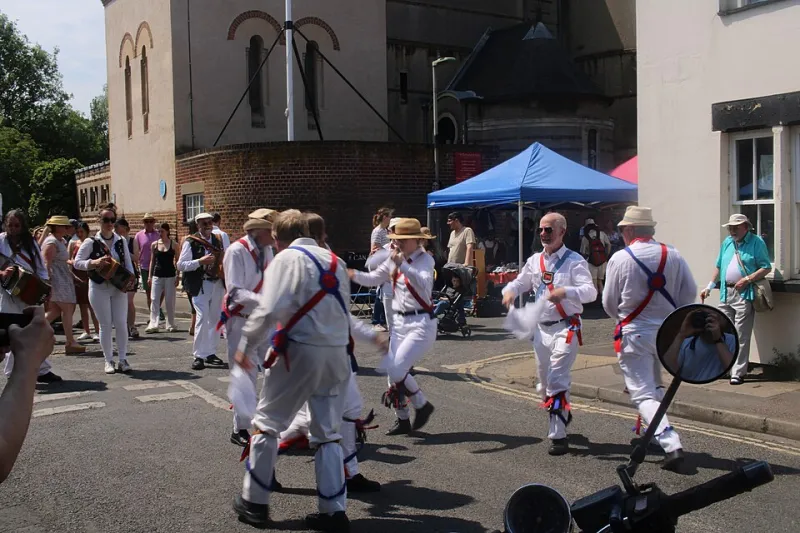
In a market square, a pub garden or on a village green, the first thing that carries is not the bells. It is the tune. A fiddle cuts through the chatter, a melodeon squeezes out a lively phrase, and suddenly people look up. The dancers are still finding their places, but the music has already told the crowd that something is about to happen.
That is the odd thing about Morris. To an audience, the dancers are the spectacle. To anyone who has stood inside a side, the musicians are the engine. They set the pace, hold the shape of the dance and cover the moments when a figure goes slightly sideways. Without them, a Morris dance is a set of instructions. With them, it becomes something people want to watch.
A small band with a big job
Most Morris sides do not have an orchestra. They have a handful of musicians, sometimes just one. The classic combination is fiddle and melodeon, but you will also hear concertina, pipe and tabor, recorder, whistle, banjo or whatever else a willing player happens to bring along. The instrument matters less than the understanding. A good Morris musician is not there to show off. They are there to keep the dance on its feet.
That means watching as much as playing. The musician needs to know where the dancers are in the figure, when the next phrase begins and whether the side is about to need a little more time or a little more lift. A tune that races ahead of the dancers is as unhelpful as a tune that drags behind them. The best players make it look effortless, which is usually a sign that they have been doing it for a long time.
What the audience is actually hearing
Morris tunes are usually built from repeated phrases, often in two parts. The A part and the B part alternate, and the dancers use those changes to mark the shape of the dance. To a listener, it can sound like a cheerful loop. To the side, it is a map. The tune tells you when to move, when to strike, when to turn and when to come back to the starting figure.
The calls are part of that map too. A squire or foreman might shout ‘once to yourself’, ‘foot up’, ‘half hands’, ‘back to back’ or ‘whole hey’. Some calls are spoken; some are hand signals; some are a look that says more than a shout ever could. The musician has to follow them, because the tune may need to stretch, pause or restart depending on what the dancers are doing. When a call goes wrong, a good musician can hold a chord or repeat a phrase and give the side a few seconds to recover. The audience rarely notices. That is the point.
Choosing the tune for the dance — and the space
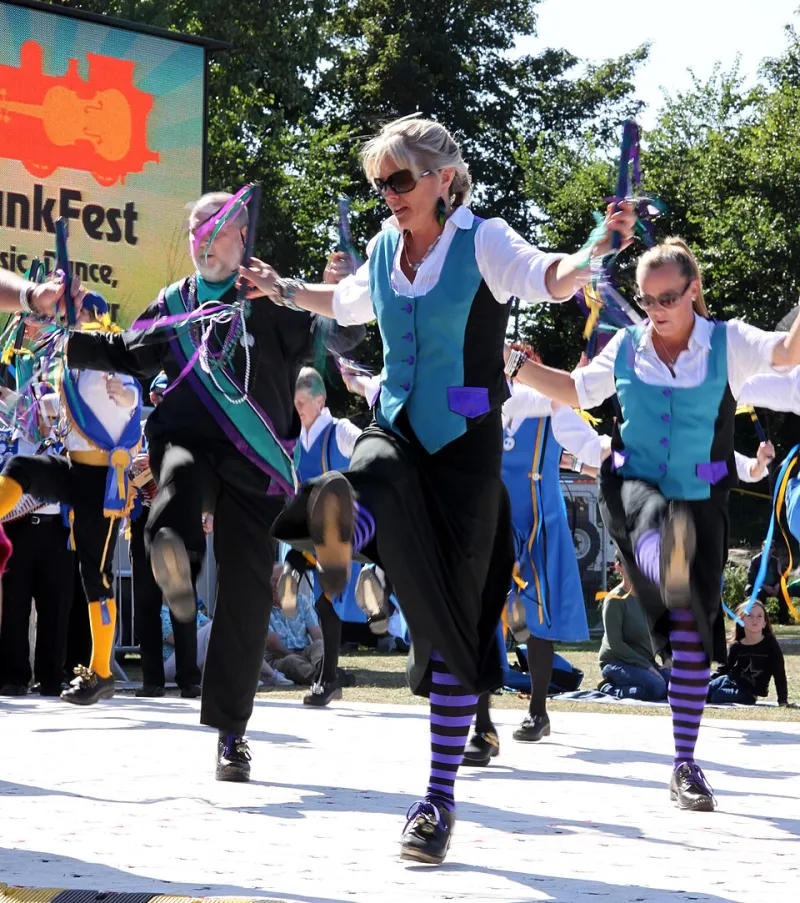
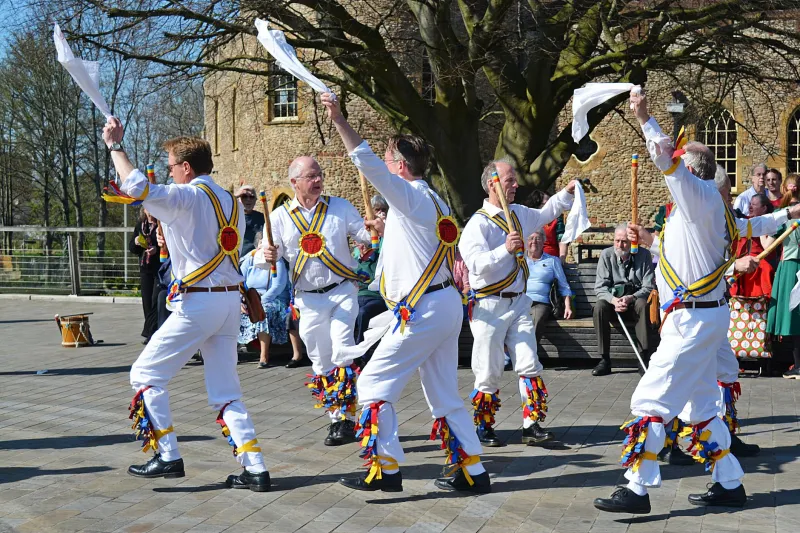
Not every tune suits every dance. Stick dances tend to want something brisk and punchy, with a clear beat for the strikes. Hanky dances can take something more flowing, where the movement of the cloth has room to breathe. Processional dances need a tune that keeps everyone walking together. A musician learns to feel the difference, and a good side learns to trust that feeling.
The space matters as well. In a busy market square, the music has to carry over traffic, shoppers and the general noise of a Saturday morning. Outdoors, the sound disappears quickly, so the playing becomes sharper and more projected. In a pub garden, the same tune might be played more quietly, with more space between the notes, because the audience is closer and the atmosphere is softer. On a village green, the wind can take the top off a fiddle, so the melodeon may need to work harder. The tune stays the same; the delivery changes.
There is also the question of key and tempo. A tune that sits comfortably on a fiddle may need transposing for a melodeon or a concertina. A dance that feels right at one speed in practice can feel sluggish outdoors, where the ground is uneven and the dancers are spread further apart. These are not glamorous decisions, but they are the ones that keep a side together.
The calls that stitch it together
Morris calls are not lyrics. They are instructions, warnings and encouragement all at once. ‘Once to yourself’ gives the dancer a moment to step into the rhythm before the side joins in. ‘Foot up’ moves the set forward. ‘Half hands’ turns the line. ‘Back to back’ sends dancers past each other. ‘Whole hey’ weaves the set into a figure that looks far more complicated than it is.
The musician and the caller work as a pair, even when they are not standing next to each other. The caller watches the dancers; the musician watches the caller and the dancers. If the caller is about to bring the side back to the start, the musician needs to be ready to repeat the A part. If a dancer is struggling, the caller might hold the figure for a few extra bars. The tune flexes. The dance survives.
Why the musician is part of the tradition
It is easy to think of the musician as accompaniment, someone standing at the edge with a fiddle while the real business happens in the middle. That gets it backwards. The music is not a soundtrack to the dance; it is one half of the conversation. The dancers respond to the tune, and the musician responds to the dancers. When it works, nobody is leading and nobody is following. The whole thing moves together.
St Albans Morris Men have been dancing in and around Hertfordshire since 1972, and the side has always depended on people who are willing to learn the tunes, carry an instrument and turn up on a cold Tuesday. Some play by ear, some read music, some have been playing the same tunes for decades. What they share is an understanding that a Morris side without music is a side with its voice turned down.
So the next time you hear the bells and see the sticks, listen for the fiddle or the melodeon underneath. Listen for the moment the tune changes and the dancers shift with it. That is the sound of a tradition being kept alive — not in a museum, but in a market square, a pub garden or a village green, with a musician keeping time and a side keeping step.