What the Founders Found: Hertfordshire’s Folk Ground Before the First Bell
Photo: Marathon , CC BY-SA 2.0, via Wikimedia Commons
St Albans Morris Men were founded in 1972. That is the date on the side’s own story, and it is a good place to start. But it is not the beginning of the story. Before the first bell was strapped on, before anyone in St Albans had argued about stick patterns or the correct way to step, there was already a long, untidy folk-dance inheritance waiting to be picked up.
The honest version is this: the founders did not invent Morris dancing, and they did not discover some secret Hertfordshire tradition that had been hidden from everyone else. They joined a conversation that was already centuries old, and they gave it a local accent. That is a less romantic sentence than ‘reviving an ancient custom’, but it is a truer one — and, frankly, more interesting.
A County of Quiet Threads
Hertfordshire is not the Cotswolds. It does not have the same famous cluster of village traditions that collectors like Cecil Sharp turned into the standard Morris repertoire. Anyone looking for a neat, unbroken line of Hertfordshire Morris running from the Middle Ages to 1972 will be disappointed. The archives do not work like that.
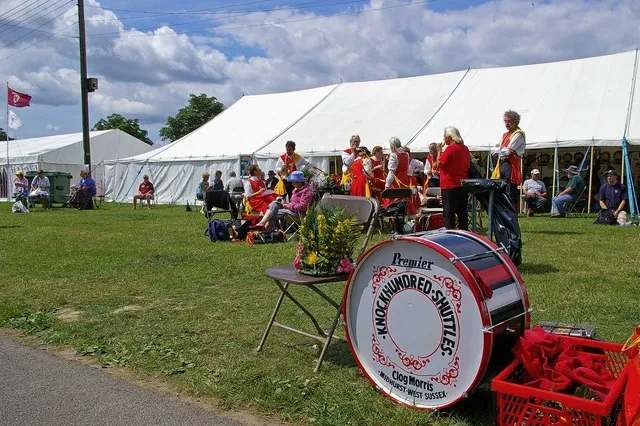
What the county does have is a broad pattern of public celebration: parish calendar customs, church ales, maying, fairs, rushbearing in some places, and the general business of people making merry in streets and inn yards. The evidence is often fragmentary — a payment here, a newspaper report there, a remembered custom recorded long after the event. It rarely adds up to a complete choreography. It adds up to a habit: people danced, processed, collected money and marked the year together in public.
St Albans itself sat at the centre of that habit. A market town with an abbey, a cathedral and a long history of inns and public occasions, it had the two things any side needs: a crowd and a reason to gather one. The founders did not have to invent a local appetite for outdoor performance. They had to find it, borrow from it and turn up on the right day.
The Revival Arrives by Book and Folk Club
By the time the side was formed in 1972, Morris dancing in England had already been through a major revival. The late Victorian and Edwardian folk revival, the work of collectors, the Esperance Club, the English Folk Dance and Song Society and a whole network of teachers and musicians had turned village traditions into a national movement. Cotswold dances from places like Headington, Bledington and Adderbury were being taught, published and performed far beyond their home villages.
This is the inheritance the St Albans founders were most likely to meet first: not a local manuscript in a county archive, but a living revival repertoire. They would have encountered it through folk clubs, dance circles, festivals, other sides and the standard books and tutors of the period. That is not a criticism. It is how most twentieth-century sides were built. You learn the tradition from the people who are already carrying it, and then you make it yours.
Post-war Hertfordshire was well placed for that. London was close, the rail lines were good, and the pub and folk-club circuit gave people a place to meet, listen and try things out. A new side could form in a town like St Albans without having to claim an ancient pedigree. It only needed a handful of people willing to learn the dances, a musician or two, and somewhere to practise.
What the Town Provided
The founders also inherited something less tangible but just as important: a town culture that already knew how to host public life. St Albans had market days, civic occasions, churchyards, greens and pub gardens. It had a cathedral and a city centre that could absorb a crowd. It had the sort of calendar where a band of dancers with bells and sticks could plausibly turn up and be understood, even if they were not quite expected.
That is the local thread. The tunes may have come from the Cotswolds, the organisational habits from the wider revival, the kit from a mixture of tradition and side choice. But the diary — the places the side has danced, the landlords who have hosted it, the passers-by who have stopped to watch — belongs to St Albans and Hertfordshire. The side did not drop out of the sky. It grew where the town already had space for public celebration.
A Borrowed Kit, a Local Accent
Every side makes choices that turn a national tradition into a local one. A name, a badge, a colour scheme, a favourite tune, a particular way of running a practice night. None of that is invented from nothing. It is selected, adapted and passed on. St Albans Morris Men are no different.
The founders inherited a set of possibilities: Cotswold dances with hankies and sticks, the bell pads and the steady stepping, the idea of a side as a group with a squire, a bagman and a musician. What they added was the local bit — the Hertfordshire addresses, the St Albans audiences and the particular stubbornness of keeping a side going through all the years since.
A Longer Story, Not a Claim
It is tempting, when writing about heritage, to make everything sound older than it is. We should resist that. There is no credible way to claim that today’s St Albans Morris Men are the direct descendants of a medieval St Albans Morris side. The evidence is not there, and the side does not need it. What we have inherited is broader and more usable: a national revival repertoire, a county habit of public festivity, a town with room for crowds, and the example of all the dancers and musicians who kept the thing going before us.
That inheritance is real even when it is not neat. It is in the tunes, the steps, the bell pads and the pub cellars. It is in the way a side teaches a newcomer without a fuss. It is in the fact that, in 2026, people still stop in St Albans when they hear bells and ask what is going on.
The founders did not invent Morris dancing. They found it, learned it, and made a place for it here. That is enough. The first bell was not the start of the story — it was the moment this side joined in.