Ink, Staple, Memory: The Paper Trail That Keeps a Morris Side Honest
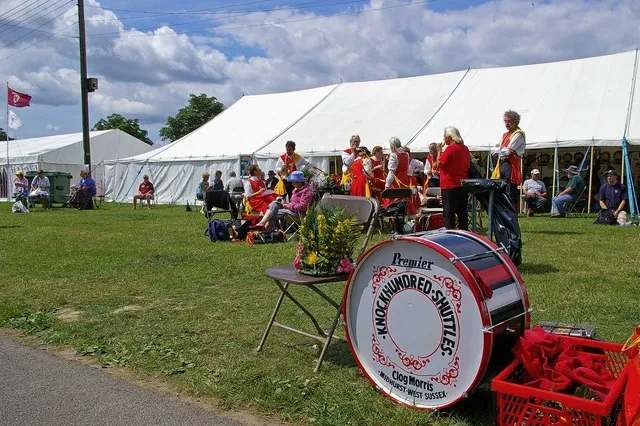
Photo: Glyn Baker, CC BY-SA 2.0, via Wikimedia Commons
There is a particular smell to old paper. Slightly dusty, maybe a bit vanillary, often faintly damp. Open a box of St Albans Morris Men’s old posters and programmes and you get that smell, followed by something more useful: evidence. Not the polished evidence of a anniversary booklet, but the working paper of a side that has been dancing in and around Hertfordshire since 1972. Faded notices, scribbled dance lists, committee minutes, photographs with names on the back — these are the bits that rarely make the website but quietly explain how the side actually works.
A Morris side’s archive is not just nostalgia. It is a paper memory of decisions. Which pub yard was usable in the rain? Which tune got dropped because nobody could remember the second part? Who agreed to buy new sticks, and who grumbled about the cost? In 2026, as the side looks back over fifty-four years and forward to the next season, those scraps are worth taking seriously.
What the scraps actually record
Start with a poster. A good one gives you a date, a venue, a time and a reason. It might also tell you what the side thought was worth advertising: ‘Traditional Morris Dancing’, ‘Licensed Bar’, ‘Weather Permitting’, ‘Collection for Local Charities’. The design changes over the decades — typefaces, logos, whether the bells are drawn large or small — but the basic offer stays recognisable. Stick a run of posters side by side and you can watch venues come and go. Cathedral Green one year, a pub car park the next, a school fete, a station forecourt, a summer fair on the edge of town.
Programmes are even more revealing. A handwritten dance list is a small piece of choreography by admin: which dances, in which order, with which musician, and how long the side expected to be on its feet. Tune names appear and disappear. Some lists are tidy. Some are on the back of an envelope. Both are useful. They show what was actually danced, not what a later summary says was danced.
Minute books are the quiet heart of it. Committee minutes record the unglamorous stuff: kit repairs, travel arrangements, fees, insurance, charity collections, whether to dance on a particular Saturday, who would ring the landlord. They also catch the tone of the side. A line like ‘agreed to leave the decision to the squire on the day’ tells you more about how a Morris side operates than any mission statement.
Photographs fill in the faces. A picture of a set outside a St Albans pub in the 1980s might show a different style of waistcoat, a different arrangement of bells, a crowd that has since moved away. Names on the back are gold. Without them, the image is still a record of kit and setting; with them, it becomes a record of people.
Why this matters to a living side
Archives are often treated as something for the end of an organisation’s life. In practice, they are useful while it is still dancing. New members can learn the repertoire’s history without being handed a lecture. Organisers can check how a venue behaved last time, or which local group a collection supported. Musicians can trace a tune’s route in and out of favour. And the side can correct its own myths before they harden.
The paper trail also maps community ties. Old programmes list landlords, school PTAs, church committees, charity organisers and neighbouring sides. Those names are a reminder that Morris dancing in St Albans has never happened in a bubble. It happens because people answer letters, book halls, lend car parks and put a bucket out on the day. The archive is a contact book with a patina.
The condition problem
Paper is fragile in ways that are easy to make worse. Sellotape yellows and fails. Laminating feels protective but traps moisture and makes future conservation harder. Damp garages, lofts with wild temperature swings, and sunny shelves all take a toll. So do well-meaning repairs with the wrong materials.
The practical answer is not complicated. Keep items cool, dry and dark. Store them flat in acid-free folders or boxes where possible. Handle with clean, dry hands and avoid folding brittle paper. Do not laminate. If something is torn, keep the pieces together and get advice before reaching for tape.
Digitisation is the obvious next step, but do it with a plan. Scan at a decent resolution — 600 dpi is a sensible target for documents — and save a master copy as a TIFF. Name files clearly with date, event and item type. Record the basics in a simple spreadsheet: what it is, where it came from, who is in the photograph, what is written on the back. Keep the original. A scan is a copy, not a replacement.
A small archive, kept alive
A side like St Albans Morris Men does not need a temperature-controlled vault. It needs a few sensible boxes, a scanning session or two, and people willing to label what they know. Prioritise the unique stuff: minute books, handwritten dance lists, posters with dates and venues, photographs with names. Back up the digital files in more than one place. Share low-resolution versions online if copyright and consent allow, but keep the high-resolution masters safe.
And ask before you publish. Photographers retain rights. People in old pictures may have moved on, or may simply prefer not to be tagged. A light touch and a credit line go a long way.
What we are asking for
This is where readers come in. If you have a poster in a drawer, a programme from a village fete, a ticket, a newspaper clipping, a song sheet, a badge, a letter about a booking, or a photograph of the side outside a pub that no longer looks the same, we would like to hear about it. Mundane is fine. A shopping list from a dance out can be more revealing than a formal history. So can a memory: who was there, what tune was played, why a venue changed, which landlord always put on a spread.
You do not have to hand anything over. Loans for scanning are welcome. So are names, dates and corrections. The side’s story is still being written, and the paper trail is part of how it stays honest. The bells are loud, but the paper is quiet. Help us keep it.